

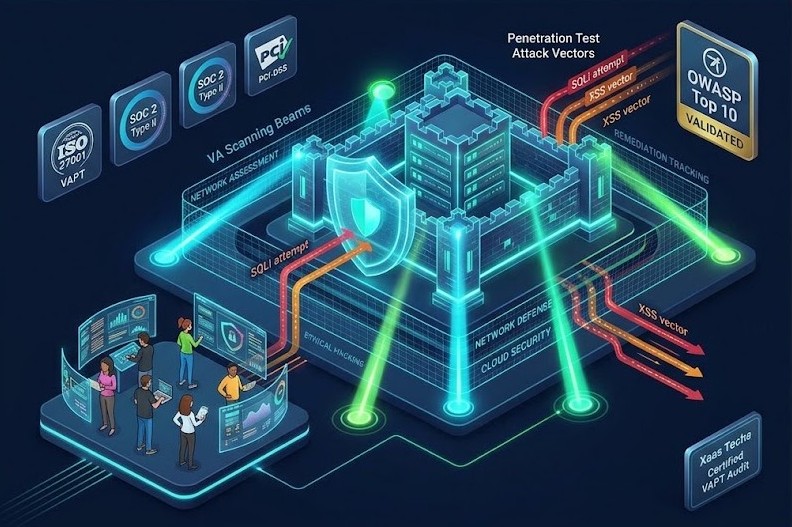
Securing enterprise digital assets requires moving from passive defense to proactive offensive testing. With distributed cloud architectures, API-driven workflows, and evolving ransomware tactics, identifying configuration flaws before threat actors exploit them is critical.
Vulnerability Assessment and Penetration Testing (VAPT) is an offensive security methodology designed to discover, evaluate, safely exploit, and remediate technical vulnerabilities across your IT infrastructure.
What Is VAPT?
VAPT combines two distinct cybersecurity processes that complement each other:
- Vulnerability Assessment (VA): An automated, systematic scan of network devices, servers, and web applications to identify known weaknesses, unpatched software, open ports, and configuration drifts.
- Penetration Testing (PT): A manual, expert-driven simulated cyberattack where ethical hackers attempt to exploit discovered vulnerabilities to bypass perimeter defenses, escalate privileges, and extract sensitive data.
| Feature | Vulnerability Assessment (VA) | Penetration Testing (PT) |
| Approach | Automated scanning & asset discovery | Manual exploitation & simulated attack |
| Focus | Breadth (finds all known vulnerabilities) | Depth (tests real-world exploitability) |
| Execution | Continuous or scheduled scans | Periodic engagement (annual/post-change) |
| Outcome | Prioritized list of technical flaws | Detailed breach path & proof-of-concept |
Core Types of VAPT Audits
- Network VAPT: Evaluates internal LAN/WAN networks, external firewalls, switches, Active Directory, and VPN endpoints to prevent unauthorized network pivoting.
- Web Application VAPT: Tests client-facing applications and APIs against the OWASP Top 10 vulnerabilities, including SQL injection (SQLi), Cross-Site Scripting (XSS), broken access control, and authentication bypass.
- Cloud Infrastructure VAPT: Assesses cloud misconfigurations across AWS, Microsoft Azure, and GCP, targeting IAM permission sprawl, unencrypted S3 buckets, and exposed storage blobs.
- API & Mobile App VAPT: Inspects REST/GraphQL endpoints, iOS/Android binary protections, and data-in-transit encryption protocols.
The 5 Phases of an Enterprise VAPT Lifecycle
- Reconnaissance & Scoping: Defining target IP ranges, domains, cloud tenants, rules of engagement (RoE), and operational black-out windows.
- Automated Scanning & Threat Modeling: Identifying open ports, services, CVE database matches, and software versions.
- Exploitation & Privilege Escalation: Ethical security testers attempt controlled exploits without interrupting production systems to validate critical impact.
- Comprehensive Reporting: Generating executive summaries for leadership alongside detailed technical remediation steps for sysadmins and DevOps engineers.
- Re-Testing & Attestation: Validating applied patches, closing open tickets, and issuing official VAPT compliance certificates.
Regulatory Compliance & Business Benefits
Conducting regular VAPT audits satisfies strict statutory mandates and vendor requirements:
- ISO/IEC 27001: Mandatory control requirements for technical compliance reviews (A.12.6.1).
- SOC 2 Type II & PCI-DSS 4.0: Requires periodic external penetration testing and quarterly vulnerability scans.
- Cyber Insurance Eligibility: Proof of periodic third-party VAPT audits is required to secure corporate cyber liability coverage.
Fortify Your Infrastructure with Xaas Techs
A single unpatched zero-day or misconfigured cloud bucket can compromise your entire business operations. Xaas Techs delivers certified VAPT auditing, comprehensive network assessments, and automated cloud security monitoring tailored for growing enterprises.
Request a VAPT Consultation & Security Audit to identify critical vulnerabilities before attackers do.
